Industries — Fintech & payments

Screening that keeps up with your sign-up rate

Payment processors, e-money issuers, wallets and remittance providers call the SafetyNet sanctions screening API from inside their own onboarding flow — one call, returning a result your sponsor bank and your regulator can both audit.

The problem

Growth is the compliance problem

Volume arrives before headcount does. Every control has to work unattended, and still produce a file someone can read six months later.

The sponsor bank

Your sponsor bank or scheme partner is accountable for you, and reviews you on their schedule. They will ask to see the control, not hear about it — which lists, refreshed how often, reviewed by whom, and what happened to the alerts.
The sign-up curve

A campaign doubles applications overnight and the compliance team does not double with it. Anything that needs a human in the loop by default becomes a queue, and a queue of unresolved alerts is itself a finding.

The drop-off

Every extra second in onboarding costs conversion. Screening that runs as a separate step, in a separate tool, after the fact, is either slowing the funnel down or being skipped.

Where it sits

From sign-up to the sponsor’s annual review

The same platform at every stage, so the audit trail is continuous instead of assembled from four tools after someone asks for it.

1

Call

One call to the sanctions screening API from your onboarding service. Identity verified and the name screened before the account funds, with the applicant still inside your flow.

2

Triage

Results arrive separated by source and risk band, so clear cases clear themselves and only the files that need enhanced due diligence reach an analyst.

3

Record

Everything that passes review becomes an entity in KYC::DB — members, ownership, documents, notes and audit trail in one place, with its own monitoring schedule.

4

Report

Risk distribution, hits by source, top high-risk matches and scheduled report delivery — what a sponsor bank asks for annually and a board asks for quarterly.

The API

What the sanctions screening API returns

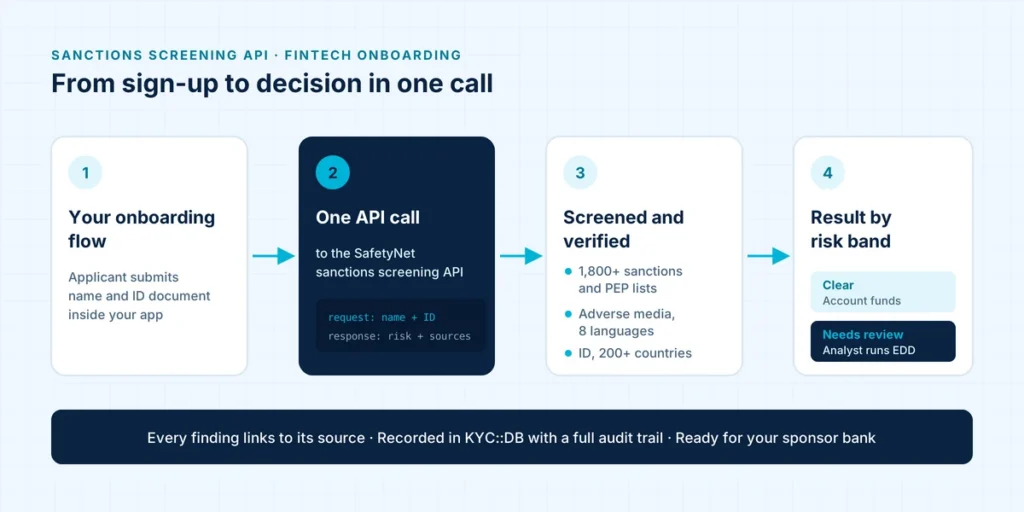
One request from your onboarding service screens the applicant and verifies their ID, and the response is ready for your decision logic before the account funds. Your existing customers are covered too: Bulk Upload rescreens over half a million records at once, and every approved customer moves onto continuous monitoring with alerts.

SafetyNet sanctions screening API flow: onboarding, one API call, screening and ID verification, result by risk band

Screening in one call

Each applicant is checked against 1,800+ global sanctions and PEP lists, with adverse media screening in eight languages, inside the request your onboarding flow already makes.

Identity verified alongside

ID documents from over 200 countries are verified in the same flow, so screening and verification produce one result instead of two tools for your team to reconcile.

Results your rules can use

Matches from the sanctions screening API come back separated by source and risk band, each with the source behind the finding, so clear cases pass on their own and your sponsor bank can see why they passed.

Next

The detail lives in two places

Everything SafetyNet does about each control is written down once, so it stays accurate. These pages are the same for every industry — this one is not. New to fintech KYC? Read our guide to KYC screening for fintech.

Ready to strengthen your risk avoidance program?

Join organizations worldwide using SafetyNet to meet KYC, AML and sanctions screening requirements with confidence, speed, and accuracy.

Compliance Alerts

Stay ahead of Compliance developments

Sign up for SafetyNet News Alerts — the latest global sanctions updates, regulatory changes, and financial crime intelligence delivered to your inbox.

No spam. Compliance news only. Unsubscribe anytime.