The subject you cannot name yet
A case often opens with an image, an alias or a company with no obvious principal. A tool that only accepts a clean full name has nothing to say until someone else has already done the hard part.
Industries — Government & investigations
Regulators, law enforcement and investigative units use SafetyNet for casework — reverse facial search, cognitive link analysis across structured and unstructured data, and a multilingual search of the surface and deep web, with a live source URL behind every finding.
The problem
A commercial KYC tool answers a yes/no question about one name. An investigation starts before you know which name matters.
A case often opens with an image, an alias or a company with no obvious principal. A tool that only accepts a clean full name has nothing to say until someone else has already done the hard part.
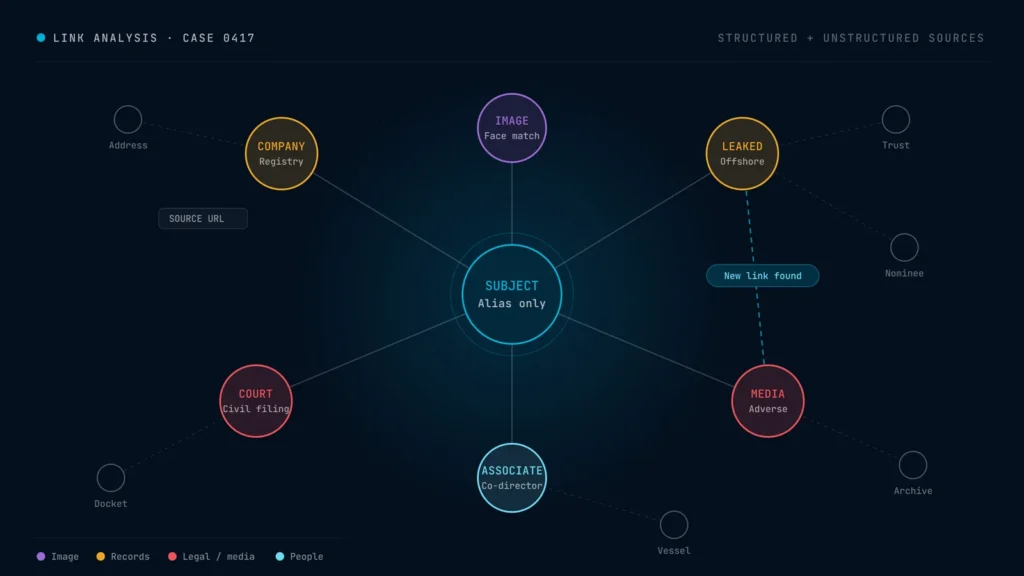
Court records, government registries, leaked-document data, adverse media and the open web each hold a piece. Assembled by hand across a dozen tabs, the connection between two of them is the thing most likely to be missed. Link analysis puts those pieces on one graph instead of a dozen tabs.
Findings are contested, disclosed, and read by people who were not in the room. A conclusion without a route back to its source is an assertion, and an access log nobody can produce is a problem of its own.
Where it sits
The same platform across the investigation, so what was looked at and when is recorded as you go rather than reconstructed afterwards.
Facial Search takes an unidentified image of a person and locates them within an image database. Where you have a name instead, screening runs it against 1,800+ lists and a 6.2M-name knowledge graph.
Facial Search is a starting point rather than a verdict: each candidate match is a lead for the investigator to confirm, not a conclusion the platform draws on their behalf.
Visualize Connections is a cognitive link analysis tool that graphically displays the connections surrounding a subject of interest, drawn from both structured and unstructured data — so the next lead comes from the graph rather than a hunch.
Because every finding carries its source URL, a connection surfaced through link analysis can be checked before it goes anywhere near the case file.
A multilingual search reads the surface and deep web in real time, returning legal and court files, crime and government registries, curated news, general internet, rich media and blog sources, separated by source.
Separating results by source lets an investigator weigh a court filing differently from a blog post, and searching across languages reaches records an English-only query would miss.
The subject becomes an entity in KYC::DB with documents, notes and audit trail, and findings export to PDF, Excel, CSV and JSON — each carrying a live URL back to the source it came from.
Because the record builds as the work happens, the case file shows what was searched, what was found and when, ready for disclosure or review by someone who was not in the room.
Next
The full detail on link analysis, Facial Search and every other capability, and which edition you need, is on the two pages below.
Facial Search, Visualize Connections for link analysis, the multilingual internet search, screening and the knowledge graph — what each one does and what it returns.
See the capabilitiesFacial Search and link analysis require EDD; Internal File Search and on-premise deployment require Enterprise. Lite is list screening only and is not suited to casework.
Compare editionsJoin organizations worldwide using SafetyNet to meet KYC, AML and sanctions screening requirements with confidence, speed, and accuracy.
Sign up for SafetyNet News Alerts — the latest global sanctions updates, regulatory changes, and financial crime intelligence delivered to your inbox.
No spam. Compliance news only. Unsubscribe anytime.