The regulatory review
Your regulator does not want your conclusion. They want the file — what was searched, against which lists, on what date, and what the reviewer saw at the time. A screenshot is not a record.
Industries — Financial services
SafetyNet is sanctions screening software for banks, credit unions and financial services teams: screen account holders and counterparties against 1,800+ sanctions, PEP and PIP (politically influential persons) lists — and keep the file that proves it, with a live source URL behind every finding.
The problem
Most sanctions screening software can return a hit. Far fewer platforms can stand up when someone senior asks how you reached that conclusion, and when.
Your regulator does not want your conclusion. They want the file — what was searched, against which lists, on what date, and what the reviewer saw at the time. A screenshot is not a record.
Correspondent banks and partners reassess the firms they deal with on their own schedule, and the burden of proof sits with you. A documented control is the difference between a renewed relationship and a closed one.
Onboarding volume does not scale with headcount, and a backlog of unresolved alerts is itself a finding. In sanctions screening software, false positives are not an inconvenience — they are where the real match gets buried.
What a finding looks like
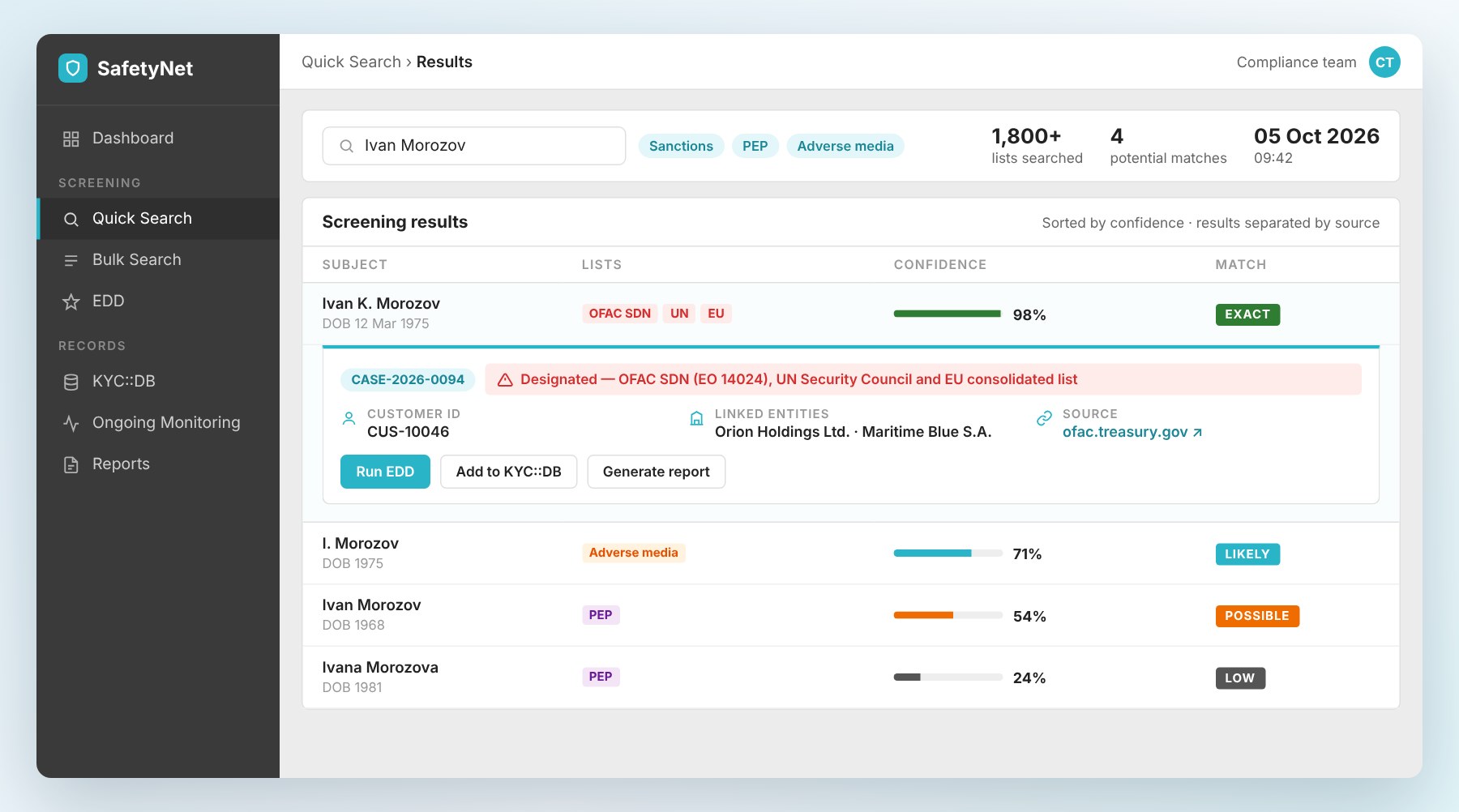
Sanctions lists such as the OFAC SDN list are updated often. SafetyNet’s sanctions screening software checks a name against 1,800+ sanctions lists, PEP databases and adverse media, and every potential match comes back with a confidence score and a live source URL, separated by source so your team can tier the relationship on what was actually found.
FATF guidance on politically exposed persons sets out why PEP relationships need enhanced checks. When a regulator or a correspondent bank asks how you reached a decision, the answer is already in the file: what was searched, against which lists, on what date, and what the reviewer saw.
Obligation register
Mapped to the controls you are assessed against. The reference codes below are SafetyNet’s own control references, not citations to a named standard. Requirements vary by sector and jurisdiction — this is the shape of the coverage, not a compliance opinion.
Ref
Obligation
How SafetyNet meets it
CDD-01
Verify customer identity at onboarding
Verify ID checks the identity document, authenticates it forensically and extracts the data from it — which feeds straight into a sanctions and PEP search without anyone re-keying a name.
SANC-01
Screen against sanctions, PEP and watchlists
Screening across 1,800+ active global lists against a knowledge graph of 6.2M names. Results are separated by source — Sanctions, PEP, Adverse Media, Court Records, Dark Web and ICIJ leaked-document data — so a PEP match is never read as a sanctions hit.
EDD-01
Apply enhanced due diligence to higher-risk relationships
A multilingual cognitive search engine reads the surface and deep web in real time, returning legal and court files, crime and government registries, curated news, general internet, rich media, and blog and opinion sources.
EDD-02
Identify beneficial ownership and associations
Link analysis maps corporate and personal connections across entities, and KYC::DB holds the members, directors, UBOs and cap table behind each one — so ownership is recorded rather than inferred.
PORT-01
Rescreen the existing book, not just new customers
Bulk Search takes the customer file, maps the columns and screens the whole book in one run. Schedule it to repeat, or re-run any batch against the latest databases, with results broken down by risk and by source.
MON-01
Monitor relationships on an ongoing basis
Ongoing Monitoring rescreens on the cycle you set — daily, weekly, fortnightly, monthly, quarterly, half-yearly, yearly or a custom interval — against a single name or a whole uploaded book, with alerts when a list changes or adverse news appears.
REF-01
Refresh customer information on a periodic cycle
Build a document and information request and send it to the customer through a secure one-time-passcode portal, then verify what comes back item by item — accepting or returning each with a reason. Everything lands in the Document Centre with version history.
REC-01
Keep records that evidence the decision
Profile reports in web and PDF, plus exports to Excel, CSV and JSON, stored securely, with a live URL from every finding back to its source so a reviewer can go and look for themselves.
GOV-01
Evidence who did what, and who was permitted to
Permissions across 13 modules with five actions each, reusable permission templates, and a full audit log on every entity and document.
RDR-01
Handle disputed and mistaken matches
Built-in redress for every file you open, so a customer wrongly flagged has a route to correction and you have a record of how it was resolved.
Where it sits
The same sanctions screening software at every stage, so the audit trail is continuous instead of stitched together from four tools afterwards.
Identity verified through Verify ID and the name screened before the account opens. Call it from your onboarding journey through the API so the applicant never leaves your flow.
Results separated by source let you tier the relationship on what was actually found. The customer record and its risk rating live in KYC::DB, alongside the members, directors and UBOs behind the entity.
Ongoing Monitoring rescreens on the cycle you set, from daily through to annual, against a single name or the whole book — with alerts when a list changes or adverse news appears.
Per-name reports for a regulator or a counterparty, plus board and management reporting: risk distribution, hits by source, top high-risk matches, and scheduled delivery of the report itself.
Why it works this way
SafetyNet is built by Domus Semo Sancus, a RegTech company headquartered in Providenciales, Turks and Caicos Islands, and used by organisations across the globe — financial regulators and investment promotion agencies, banks and credit unions, legal, accounting, corporate services and real estate firms, and other regulated sectors. This page is the financial services view of it.
What you are asked for changes with the sector and the jurisdiction; the burden of proof does not. Evidence is a first-class output rather than an afterthought you export, and SafetyNet’s sanctions screening software is global from the outset — because your counterparties rarely sit in one country.
Assurance
The questions your IT risk committee asks before your compliance team gets a say.
Run SafetyNet in the cloud, in a hybrid cloud, or on-premise on your own infrastructure with Enterprise — so a data residency requirement is answered by where the system sits, not by a contractual promise about it.
Permissions run across 13 modules with five actions each, applied through reusable templates rather than set per person. Every entity and every document carries a full audit log, so “who saw this, and when” is a query and not an investigation.
Documents collected from customers land in the Document Centre with version history, and findings export to PDF, Excel, CSV and JSON for your own archive.
Which edition
Editions are cumulative — everything in a lower edition carries into the ones above it.
Screening and redress for every file you open.
Investigate beyond the lists, with your team.
Your own data, your own deployment, your whole organisation.
A tier in its own right rather than an add-on — REST API access to SafetyNet EDD, so screening happens inside core banking, onboarding or case management instead of in a second window.
Contact salesQuestions
It checks customers and counterparties against sanctions lists, PEP lists and adverse media before and during a relationship. SafetyNet screens against 1,800+ sanctions, PEP and PIP lists, with a live source URL behind every finding.
On the cycle you set, from daily through to annual, against a single name or the whole book, with alerts when a list changes or adverse news appears.
Per-name reports showing what was searched, against which lists, on what date and what the reviewer saw, plus board reporting on risk distribution and hits by source.
Most run EDD: list screening plus internet search, link analysis, integrated ID verification and multi-user access. Enterprise adds on-premise or hybrid deployment where data residency is a requirement.
Yes. Call it through the API from your onboarding journey, so the applicant never leaves your flow.
Join organizations worldwide using SafetyNet to meet KYC, AML and sanctions screening requirements with confidence, speed, and accuracy.
Sign up for SafetyNet News Alerts — the latest global sanctions updates, regulatory changes, and financial crime intelligence delivered to your inbox.
No spam. Compliance news only. Unsubscribe anytime.