A CFATF mutual evaluation judges your country, but your credit union lives with the result. When assessors find gaps in how a jurisdiction prevents money laundering and terrorist financing, supervisors tighten expectations. Correspondent banks start asking harder questions. Small compliance teams feel it first.
The good news is that readiness is practical work. Most of what assessors look for in the financial sector comes down to a handful of controls: know your member, know who really owns or controls an account, screen against sanctions and PEP lists, keep monitoring, and keep records you can produce on request.
This guide explains what the evaluation is, why it matters to credit unions in particular, and what your team can do over the next twelve months.
What a CFATF mutual evaluation is
A mutual evaluation is a peer review. The Caribbean Financial Action Task Force (CFATF) sends a team of assessors from other member countries to check how well a jurisdiction applies the FATF Recommendations, the international standard against money laundering, terrorist financing and proliferation financing.
Assessors rate two things:
| What is rated | What it asks | Rating scale |
|---|---|---|
| Technical compliance | Do the laws, regulations and powers exist for each of the 40 Recommendations? | Compliant, Largely compliant, Partially compliant, Non-compliant |
| Effectiveness | Do those rules actually work in practice, across a set of Immediate Outcomes? | High, Substantial, Moderate, Low |
Effectiveness is where most jurisdictions lose marks. A law on beneficial ownership counts for little if banks and credit unions cannot show they apply it.
The FATF’s methodology for the new round of evaluations puts even more weight on effectiveness and on a country’s main risks. It also assesses financial institutions and non-financial businesses separately, and evaluations run on a six-year cycle instead of roughly ten. Source: FATF methodology overview.
The CFATF publishes its evaluation timetable on its mutual evaluation schedules page. Check it for your jurisdiction’s onsite date.
Why credit unions feel the result
Credit unions rarely make the headlines in an evaluation report, but they carry its consequences in three ways.
Correspondent banking. A weak rating, or a place on the FATF’s list of jurisdictions under increased monitoring, makes foreign banks more cautious. Smaller institutions are usually the first to face extra questions, higher fees or closed relationships.
Supervisory pressure. After an evaluation, supervisors act on the findings. Expect more on-site inspections, more data requests and less patience for controls that exist on paper only.
Evidence on demand. Assessors may meet regulated institutions during the onsite visit. Your supervisor may also ask you for figures before it: how many members were screened, how many matches were reviewed, how many reports were filed. A credit union that can pull those numbers quickly helps its whole jurisdiction.
Readiness checklist for your credit union
Work through these with your compliance officer. Each one maps to a question assessors or your supervisor are likely to ask.
- Risk assessment. You have a written, dated institutional risk assessment that reflects your members, products and channels, and it was reviewed in the last year.
- Customer due diligence. Every member is identified and verified before the relationship starts, and files show what was checked. See CDD vs EDD.
- Beneficial ownership. For business and trust accounts, you record who ultimately owns or controls them, not just the signatories. See what is a UBO.
- Sanctions and PEP screening. Members are screened at onboarding and again when lists change. Sanctions matches and PEP matches are handled as separate things. See what is a PEP.
- Enhanced due diligence. Higher-risk members trigger documented extra checks and senior sign-off.
- Ongoing monitoring. Unusual activity is flagged and reviewed, with a reason recorded for every decision to clear or escalate.
- Reporting. Staff know how and when to file a suspicious transaction report, and you can show the count and timeliness of reports filed.
- Record keeping. You can retrieve any member file, screening result or decision within the period your law requires.
- Training. Front-line and back-office staff have recent, recorded AML/CFT training relevant to their role.
If you can confirm fewer than seven, start with the gaps below.
Common gaps in small compliance teams
| Gap | Why it hurts | How to close it |
|---|---|---|
| Screening only at onboarding | Members added to a sanctions list later go unnoticed | Re-screen the whole book when lists update, not just new members |
| Ownership taken on trust | Signatories are recorded, real owners are not | Ask for the ownership chain on every business account and record each owner |
| Decisions without reasons | A cleared match with no note looks like no review happened | Require a short reason for every clear, escalate or dismiss |
| Spreadsheets as the audit trail | Files go missing, versions conflict, nothing is time-stamped | Move screening and decisions into a system that logs who did what, and when |
| Too many false positives | Analysts rush through alerts and miss real ones | Use better matching data and tune thresholds instead of hiring more reviewers |
| Figures nobody can pull | The supervisor asks for statistics and the team rebuilds them by hand | Keep running counts of screenings, matches, escalations and reports |
A twelve-month readiness timeline
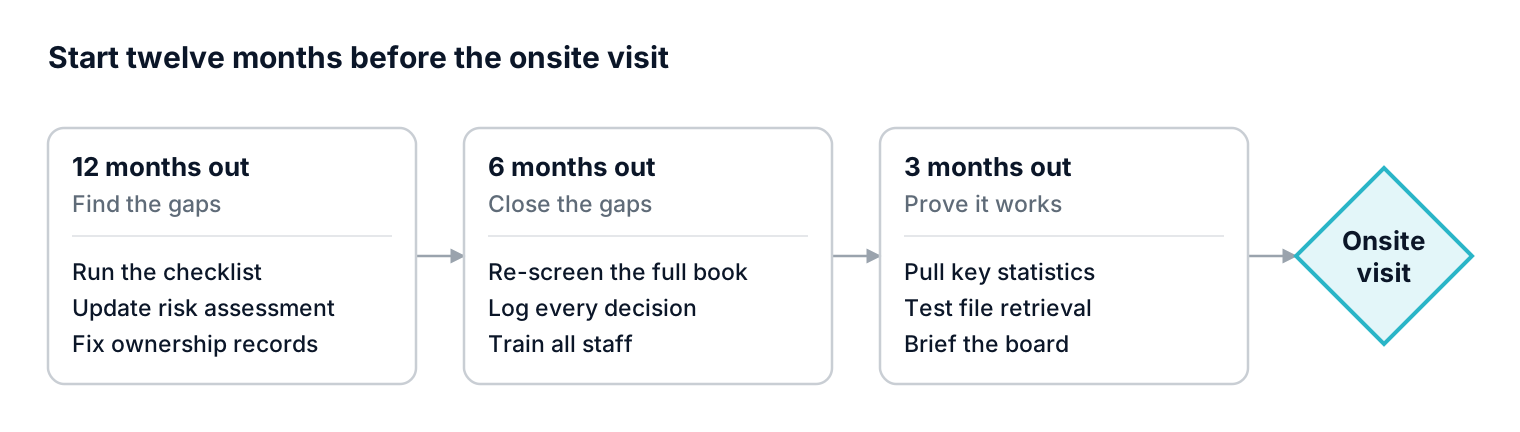
- 12 months out: find the gaps. Run the checklist, update your risk assessment and fix ownership records.
- 6 months out: close the gaps. Re-screen the full member book, log a reason for every decision and train all staff.
- 3 months out: prove it works. Pull your key statistics, test that you can retrieve any file, and brief the board.
Give yourself a year. Spend the first quarter finding gaps, the middle months fixing them, and the last three months proving the fixes work with real numbers and real files.
How SafetyNet helps
SafetyNet gives a small team the controls assessors expect without adding headcount. It screens members across 1,800+ active global lists against a knowledge graph of 6.2M names, and keeps sanctions, PEP and adverse media results separate so a PEP match is never read as a sanctions hit.
Every decision to clear, escalate or dismiss is logged with who made it and when. Link analysis records beneficial owners and connections instead of leaving them to memory. Analysts make the final call on every match. The full mapping of obligations to controls is on our control coverage page, and sector detail is on Financial Services.
Not sure where your team stands? Take the free CFATF readiness check for a prioritised gap analysis, or request a demo.
Frequently asked questions
Does a CFATF mutual evaluation assess individual credit unions?
No. It rates the jurisdiction. But assessors may meet regulated institutions, and supervisors use the findings to set what they expect from you.
How often do mutual evaluations happen?
Under the FATF’s new methodology, each jurisdiction is evaluated on a six-year cycle.
What is the difference between technical compliance and effectiveness?
Technical compliance asks whether the right laws exist. Effectiveness asks whether they work in practice. Effectiveness is usually harder to score well on.
What happens if a country is rated poorly?
It enters a follow-up process and may be placed under increased monitoring by the FATF. That often leads to tougher scrutiny from correspondent banks.
Where can I see my country’s evaluation date?
On the CFATF’s published mutual evaluation schedule.
This article is general information, not legal or compliance advice. Requirements vary by jurisdiction; confirm them with your supervisor.