The demo went well. The compliance team liked the screening, the reviewers liked the audit trail, and the shortlist is down to one. Then the proposal reaches the IT risk committee, and someone asks the question that stops everything: “Where will our customer data actually live?”
We hear some version of that question in almost every conversation with banks, credit unions and agencies. Sometimes the honest answer is that you need on-premise AML software, running on servers you control. Often, a well-run cloud service is the safer and simpler choice. The trouble is that “data residency” means different things to different people, and teams can spend months arguing about the wrong requirement.
So let’s untangle it.
First, figure out what you are actually being asked for
Three ideas tend to get mixed together in these discussions:
- Data residency is about geography: which country, and which data centre, your data physically sits in.
- Data sovereignty is about law: whose rules govern that data. Data stored in your country can still be reachable under another country’s laws if the provider is based there.
- Access and control is about people: who can see the data, and whether you can hand it to your supervisor quickly when they ask.
These requirements can come from data protection law, from your financial supervisor, or from your own board. They differ from one jurisdiction to the next. Before anyone debates servers, get the actual wording in front of you. You may find, as many teams do, that the real requirement is about access and control rather than a specific server location.
Cloud, hybrid or on-premise AML software: the honest trade-offs
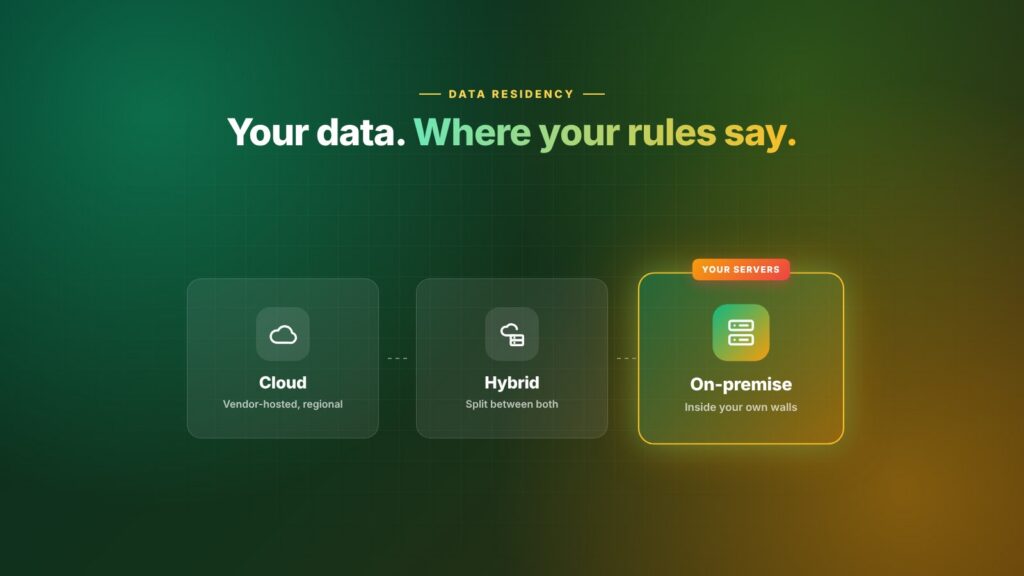
| Cloud | Hybrid | On-premise | |
|---|---|---|---|
| Where your data sits | The vendor’s hosting, ideally in a region you choose | Split: sensitive data on your side, some services in the cloud | Your own servers, in your own data centre |
| Who looks after it | The vendor | You and the vendor together | Your IT team, with vendor support |
| How fast you’re up and running | Fastest | Somewhere in between | Slowest |
| Upgrades and list updates | Happen automatically | Mostly automatic | Your team schedules and applies them |
| Load on your IT team | Light | Moderate | Heavy |
| Usually right for | Most institutions without a strict location rule | Teams that must keep customer data local but want cloud convenience | Strict residency rules, government agencies, or boards that rule out external hosting |
Seven questions worth settling before you sign anything
- What does the rule actually say? “Data must stay in the country” and “data must be available to us on request” sound similar but lead to very different decisions.
- Which data does it cover? Customer records, screening results, case notes and audit logs may each be treated differently. The sanctions lists themselves are public.
- Are transfers allowed with the right safeguards? Some rules permit cross-border transfers under contract or to approved countries. If yours do, regional cloud hosting may be all you need.
- Can your team really run it? On-premise means servers, patching, backups, monitoring and a disaster recovery plan. Ask your IT lead honestly whether they have the time.
- How will list updates reach you? Sanctions lists change often. A beautifully secure system that is a week behind on updates is still a compliance gap.
- How will you prove who saw what? Whatever you choose, you will need role-based permissions and an audit log of every decision.
- What happens if you ever leave? Find out now how you would export your records, decisions and audit trail in a format you can actually use.
So when does on-premise AML software make sense?
Choose on-premise AML software when a law, a supervisor or your board genuinely requires customer data to stay on infrastructure you control, and when your IT team has the capacity to run it well. Government agencies, investigative bodies and some banks are firmly in this camp, and for them it is the right answer.
For everyone else, cloud is usually the better place to start. You get going faster, list updates arrive without anyone lifting a finger, and there is far less to maintain. If you are somewhere in between, hybrid lets you keep customer data on your side while still handing the heavy lifting to the vendor.
Three things we wish people stopped believing
“Cloud is less secure.” Not automatically. A cloud service with proper encryption, access control and monitoring can be far more secure than a stretched server room. Judge the controls, not the postcode.
“On-premise means we’re compliant.” Location only answers the residency question. You still need current lists, documented decisions, access control and records you can produce when asked.
“A local data centre settles it.” Only if geography is the whole requirement. If the concern is sovereignty or access, check who operates the hosting and which laws they answer to.
Where SafetyNet fits in
We have sat through enough of those IT risk committee meetings to know that one deployment model never fits everyone. So SafetyNet lets you choose. It runs in the cloud by default, with regional hosting options for data residency requirements. On the Enterprise edition, you can run it in a hybrid cloud or as on-premise AML software on your own infrastructure, so your residency requirement is answered by where the system sits, not by a promise in a contract.
Wherever it runs, data is encrypted at rest and in transit, permissions are role-based, and every decision is logged with who made it and when. You can compare the editions on our plans page, or see how each control is covered on our control coverage page.
Not sure which model your rules point to? Start a free trial and tell us what you’re working with. We’re happy to talk it through.
Questions we often hear
What exactly is on-premise AML software?
It’s anti-money laundering software that you install and run on your own servers, in your own data centre, instead of using a version the vendor hosts. Your customer data never leaves infrastructure you control.
Are regulated institutions allowed to use cloud AML software?
In many places, yes, as long as you meet the data protection, outsourcing and access rules that apply to you. Rules differ, so check your local law and your supervisor’s guidance.
What’s the difference between data residency and data sovereignty?
Residency is where your data physically sits. Sovereignty is whose laws govern it. Your data can live in one country and still be subject to another country’s laws, depending on who runs the hosting.
What does “hybrid” mean in practice?
Part of the system runs on your infrastructure and part in the cloud, so sensitive customer data can stay with you while other services stay managed by the vendor.
Does on-premise AML software still get sanctions list updates?
It should. Ask any vendor exactly how updates reach an on-premise installation and how quickly they are applied. Out-of-date lists are a compliance gap, however secure the system is.
This article is general information, not legal or compliance advice. Requirements vary by jurisdiction; confirm them with your supervisor.